
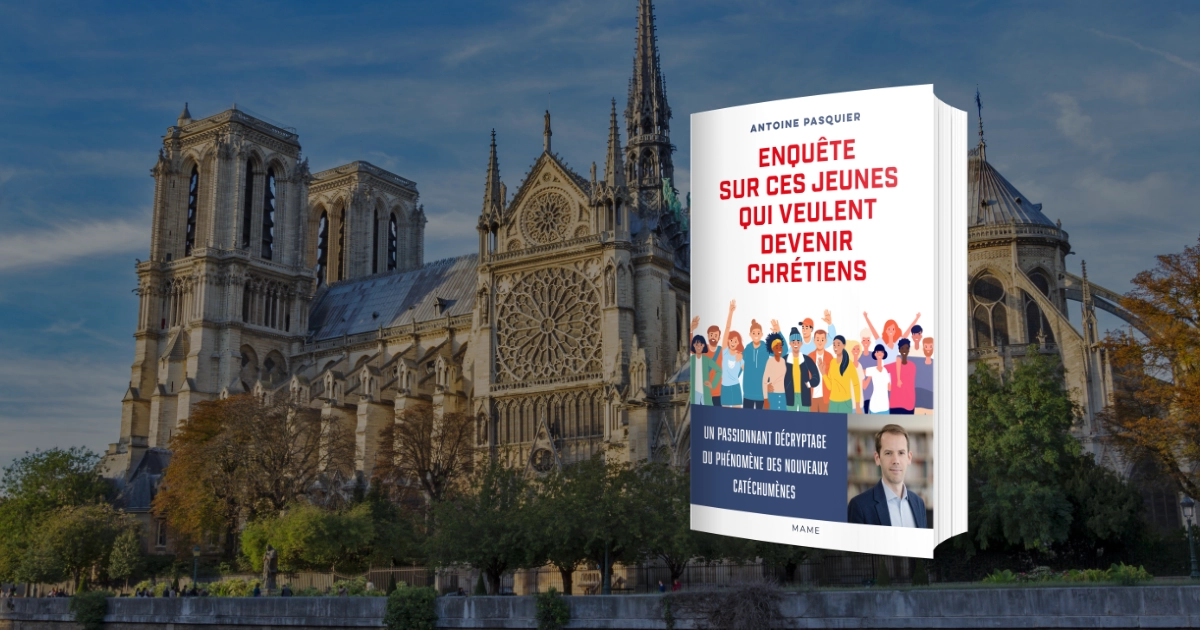
Enquête sur ces jeunes qui veulent devenir chrétiens (A Study on These Young People Who Wish to Become Christian)
Antoine Pasquier
Mame
Sept., 2025
174 pages
ISBN: 978-2-7289-3607-7
Recent signs of growth in the Church in France have attracted overseas media attention. While overseas analyses are of interest, Antoine Pasquier’s recent book provides a welcome French perspective on this development. The book responds to what its author calls an “unexpected harvest”—a sharp recent increase in the number of adult and adolescent baptisms in France.
In 2025, there were almost 18,000 adult and adolescent catechumens receiving baptism—over 10,000 adults and almost 8,000 adolescents aged 11 to 17. The equivalent figures for 2022 were around 4,000 and 1,500 respectively. Among the adults in 2025, young people of 18 to 25 years old represented more than 40 percent of the total. (For more details, see the website of the French Catholic bishops, eglise.catholique.fr.)
Pasquier’s book seeks to understand these new catechumens. It finds that they are people who experienced a growing interior call and sense of God’s presence, even in a non-religious family context. They often made their journey to the Church, at least initially, on their own rather than in liaison with Church bodies, and needed time for their religious conviction to mature.
Pasquier has highlighted the determination and patience of catechumens and mentioned a young woman who waited nine years between first entering a church and her official request for baptism. Catechumens didn’t necessarily have family support or understanding, though the influence of a faith-filled grandmother sometimes made a difference. Factors of importance in their paths to conversion included reading the Bible—and Biblical sales have increased recently in France—the Internet, their own experience of suffering, and the support of friends.
Many of the new catechumens came from non-practicing and sometimes even anti-clerical families and received little religious formation in their youth but had no entrenched “hang-ups” about the Church. They were also seeking greater structure in their lives as they reached adulthood. Islam was a factor in the background in the sense that the unashamed religious practice of young Muslim believers provoked reflection among the catechumens about the strength of their own witness and practice.
Why the choice of the Catholic Church? Pasquier presents the Church as counter-cultural or as a “sign of contradiction” in relation to contemporary culture, a “lighthouse” and a “refuge,” notably through its liturgy and religious heritage. It’s also a “visible Church,” for example, at the time of papal visits or major public pilgrimages.
There are “unexpected” doors of entry into the Church—the attraction of the liturgy, and particularly of the Mass, and of the Lenten season, where there is a correspondence between the thirst for radical commitment of young people and this annual period of penance and conversion. One might add that some young people are coming to the Church through their encounter with the Latin Mass/“extraordinary form” of the Mass.
Pasquier’s book raises important questions. For example, how do catechumens fare in parish life after their baptism? How welcoming is the parish community to its new arrivals?
The author contends that parishes are not always well prepared for the new influx. The catechumens are new brothers and sisters in Christ but are not always seen as such. He reflects on how the Church should respond to this new challenge and opportunity and links the French experience to positive developments in other countries like Britain.
He highlights the need for improved training for both catechists and catechumens and gives examples of interesting pastoral initiatives: for example, in one parish in Paris, two coordinators dedicated to catechumens have been appointed, and there is now a monthly meeting between catechumens and the parish priest.
The book’s conclusion is that there is a need for the Church to become a place of transmission and evangelization, to move beyond excessively individualistic approaches and toward a “catechumenal Church,” where the Christian community reaches out to the whole surrounding population.
The author is a journalist with the popular Catholic weekly Famille Chrétienne and works with catechumens in his own parish, so is able to draw on both his journalistic and parish experience. This stimulating and clearly presented study encompasses twenty interviews with catechumens and a further twenty with sponsors and also reports on an online questionnaire of over 300 catechumens and “neophytes” or recently baptized persons.
The book could be read in conjunction with other publications, such as a larger quantitative study in March 2025 from the new Observatory on French Catholicism (observatoire-catholicisme.fr). It surveyed a representative national sample of more than 2,000 respondents over 18 and was covered in the July–August issue of the excellent Catholic monthly La Nef. The study found, for example, that only 41 percent of those surveyed believed in God. Over three-quarters of respondents were baptized, but this figure dropped to 42 percent for 18- to 24-year-olds. Of those who are baptized, only 61 percent plan to baptize their own children. The growth in adult baptisms, in other words, is very good news but will not compensate for the declining numbers of unbaptized children. On the other hand, the Observatory study found that over half of French people pray or meditate, which is a positive indicator of spiritual hunger, at least among a significant segment of the population.
In Métamorphoses Françaises (Éditions du Seuil, Paris, 2024), Jérôme Fourquet, the respected political analyst and pollster, provided striking data on more long-term trends, specifically the decline of Catholicism in France over a long time period. In 1961, 35 percent of French people went to Mass every Sunday or more often, while the figure for 2012 was 6 percent. There were 25,000 Catholic priests in 1990 and just over 10,000 in 2020. In 1900, around one fifth of newborn girls received the name “Marie,” but the percentage was 0.3 percent in 2016.
An excessively rose-tinted view of the situation of French Catholicism should thus be avoided, but one needs to keep in mind both sides of the picture—the long-term structural decline but also the recent positive news about adult and adolescent baptisms. One should also keep in mind France’s wonderful Christian religious heritage. In his letter in May to the French bishops, Pope Leo highlighted this heritage, including the contribution of saints like John Eudes, Jean-Marie Vianney, and Thérèse of the Child Jesus, and suggested that it should inspire a dynamic new missionary effort in France.
The innovative former archbishop of Paris, Cardinal Jean-Marie Lustiger, also used to speak in a hope-filled way about the future of the Church in France. His view was that European societies were rich with a Christian culture but had almost lost the memory of that culture because they had lost a strong awareness of their relationship to God. Now a new generation was rediscovering both that culture and that awareness. In view of so many signs of hope, including many conversions, the cardinal once suggested, it seemed that the old tree of the Church in France was about to bud forth once more!