
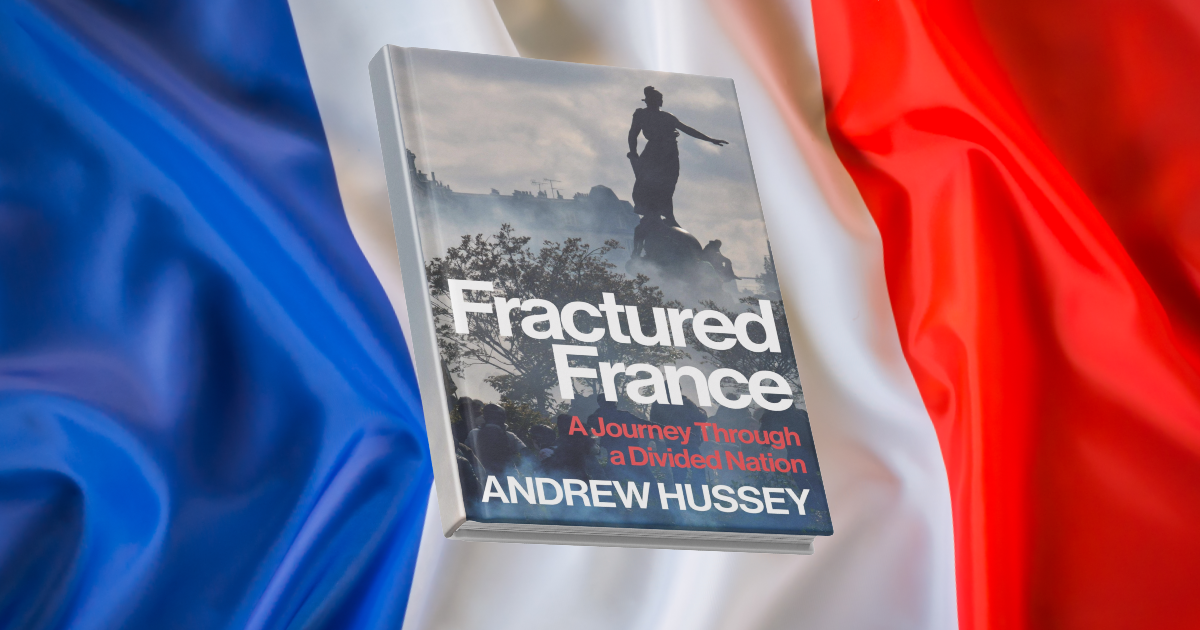
Fractured France: A Journey Through a Divided Nation
Andrew Hussey
Granta Books (London)
11 September 2025
336 pages
ISBN: 978-1-78378-660-2
The last decade has not been a good one in the history of France. Economic malaise, terrorist attacks, social tensions, and a shocking rate of prime ministerial turnover do not speak well of what the country has become. Outside observers eager to learn more about what is happening should look to Andrew Hussey’s Fractured France: A Journey Through a Divided Nation.
A Liverpudlian writer and historian who has made his home in France for the last forty years, Hussey follows in a long line of perceptive English writers who have contributed richly to the study of French history, such as Alfred Cobban, Richard Cobb, Alistair Horne, and Julian Jackson. For all the difficulties in the Anglo-French relationship, talented English intellectuals clearly have a genius for understanding the “sweet enemy” across the Channel. Hussey builds on the contributions of those who went before him while explaining how the atmosphere of the country has changed so starkly in recent times.
The French Right and the French Left have been in conflict since 1789; indeed, the entire concept of Right and Left in political science begins with the French Revolution. This is not an examination of that battle, though. Early on, Hussey quotes the native commentator Christophe Guilluy, who explains that the old divide is no longer what it was: “Until now, France has always been like a family, divided between the Right and the Left, who might have hated each other but everyone knew their place in society because it had a recognisable tradition.” He further contends that that tradition is fading, so that the new divide is between those who can afford to live in the big cities and those who cannot. As in America, people living in regions that have been left behind are increasingly gravitating to the right—and in the French case, to the far right.
Hussey takes the reader on a grand voyage across the countryside, exploring locations such as Paris, the poverty-ridden areas along the Belgian border, cuisine-obsessed Lyon, and of course Marseille, where the painful legacy of French Algeria still lives on. In taking such a wide sweep, the author does a good job of explaining the contested definitions of la France profonde (“deep France”), usually taken to mean the idyllic rural nation that has gradually emptied out as people flocked to the cities. It is impossible not to be struck by the sheer variety of the regions he describes.
Metropolitan France did not have an empire—it was an empire: one that spent much of the last few centuries suppressing the regional identities and languages within France’s borders, as described in Eugen Weber’s sublime book Peasants into Frenchmen. For a long time, this forced process of centralisation and standardisation appeared to have worked. Although it had to shed its colonial possessions in the mid-twentieth century, postwar France prospered economically and, along with West Germany, became the driver of the European integration project. The degree to which recent French governments have struggled to contend with social and economic challenges is all the more serious when judged against the general stability since the Fifth Republic was established by de Gaulle in 1958.
Politics is a key part of Hussey’s narrative. He is familiar with the intellectual developments on the French Right (including the work of controversial writers like Jean Raspail and Michel Houellebecq) and has covered political issues such as the rise of Le Pen’s National Rally, but he cannot be fairly accused of sympathising with them. This book does not advocate anything; it merely seeks to explain how the sense of simmering anger can now be detected across the country.
Islam looms large in the background. If anything, Hussey goes out of his way to avoid potentially inflammatory discussion, but the facts are what they are. We are now a decade on from the watershed year of 2015, which began with the Charlie Hebdo massacre and ended with the murderous rampage in the Bataclan theatre and on Parisian streets. Further Islamist outrages have followed, and the country will likely not return to the calmness experienced prior to that point.
Sailing into the captivating city of Marseille, Hussey describes the sight of the Basilique Notre-Dame de la Garde, which dominates the skyline and “exactly mirrors the Notre Dame d’Afrique in Algiers, which was built roughly at the same time.” On either side of the Mediterranean, the two basilicas proclaimed the dominance of France and its ancient Catholic faith. When the French settlers—the pieds-noirs—were forced to leave Algeria in the 1960s, many came to live in the south. The pieds-noirs quickly succeeded in getting the authorities to name a square in Marseille after the basilica they had left behind. Now, as Hussey writes, the “Square Notre Dame d’Afrique is regularly graffitied with anti-pied-noir and anti-French insults in French and Arabic.”
In Marseille and across France, generations of those descended from Algerian Muslim immigrants have grown up in a society from which they often feel alienated. Given that the Algerian community constitutes about 12 percent of the overall population, this is no small thing. The author makes clear that the Muslim minority has grounds to feel aggrieved. He describes how he was the victim of an assault in Dijon in the 1980s that ended with the arrival of a police car. “The first thing the police asked me in my bloodied and shattered state was whether my attackers were North African,” he writes. “When I said they probably were, they shook their heads. They would be impossible to find, they said. They were all just savages anyway.”
For all France’s glories, the country’s people were never renowned for their forbearance toward foreigners. In the last half century or so, France has been one of the European societies that pursued the experiment of mass immigration to the greatest degree, with many of the immigrants being Muslim Algerians coming from a land that France had recently been expelled from by force. This was hardly a recipe for success, nor did the strict separation of Church and State allow for the integration of the newcomers.
Hussey’s surface-level analysis of the situation calls to mind the words of Winston Churchill in Great Contemporaries, where he wrote that the “French have a dual nature in a degree not possessed by any other great people.” This divide between Republican France and Catholic France—France of the Revolution and France of Joan of Arc—amazed Churchill, but so too did the ability of the two sides to come together when threatened by an external enemy, as in the First World War. Adding a new and radically distinctive element to France has proved far more difficult than secularists would have imagined, and Hussey writes that the self-confidence of those on the Left has been seriously impacted.
“Universalism is now mostly alien to much of the Left in France, which has, confused by the politics of race and religion, suffered a loss of faith in the project of the Enlightenment as a universal ideal,” Hussey suggests. This shattered faith in France itself is surely a much more serious problem than the looming financial crisis. Across many of the regions that Hussey visits, there is a sense of economic decline. France’s national debt is higher than that of almost any other EU member, and it has been persistently breaking the EU’s fiscal rules by running very large budget deficits. The author singles out “the high quality of everyday life” (in both material and cultural terms) as one of the key attractions to life there, but it is becoming ever clearer that the French as a nation are no longer capable of affording that lifestyle, or making the political decisions required to live more modestly.
If this excellent book has a weakness, the lack of a clearer focus on the Church is one obvious criticism. Even though the rate of religious practice remains low overall, this is inexcusable. Some of the most poignant moments in France’s recent social and cultural life have revolved around Catholicism: the murder of Abbé Jacques Hamel in 2016, the fire in Notre-Dame de Paris, and the sharp increase in attacks on Catholic churches nationwide. None of this is dealt with properly here. Instead, it is touched upon obliquely, as when Hussey recounts a wine-filled evening with Michel Houellebecq in the 1990s, during which the famous writer explained the themes of his upcoming book: “the end of Christianity, the death of Western civilisation. Cause of death? Suicide.”
France is perhaps not going to do away with itself yet. The religious revival that is taking shape there—the record numbers of adult baptisms being recorded, for one—suggests that the current fracturing could have regenerative effects. With the old Right/Left duality fading away in the country where it first developed, the rest of the West should study the intensifying social divisions that have replaced it, and Fractured France is a good starting point.