
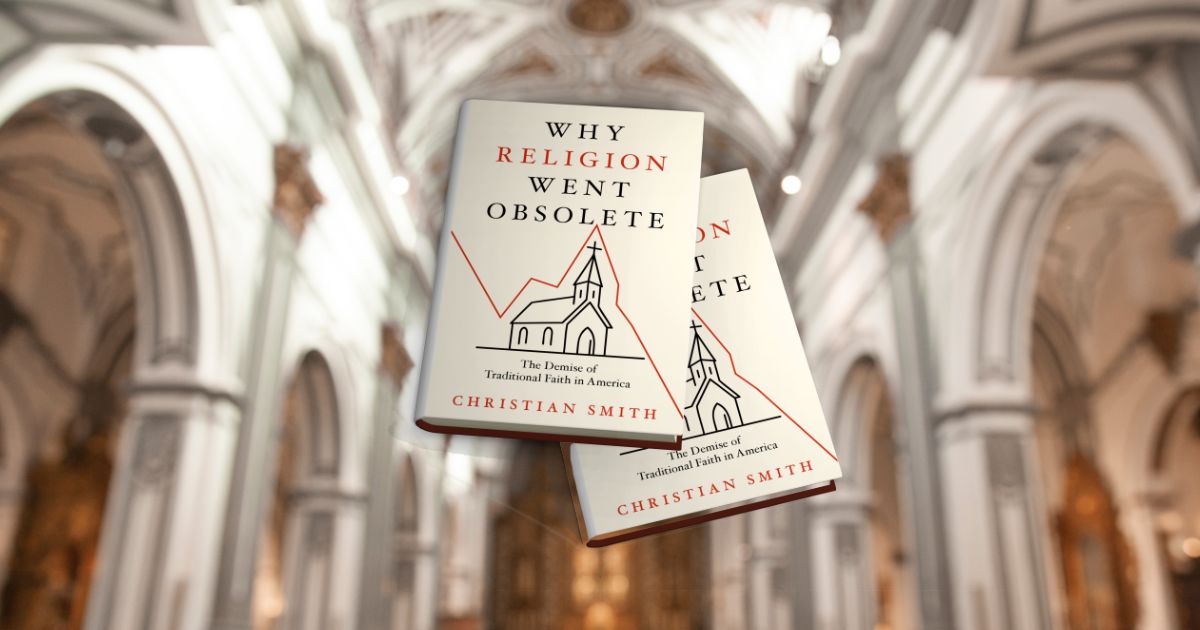
Why Religion Went Obsolete: The Demise of Traditional Faith in America
Christian Smith
Oxford University Press
April 2025
440 pages
ISBN: 978-0-19-780073-7
Why Religion Went Obsolete: The Demise of Traditional Faith in America is the new book by Christian Smith, professor of sociology and director of the Center for the Study of Religion and Society at the University of Notre Dame. One of the foremost authorities on American religiosity, Smith is known for helping to coin the phrase “moral therapeutic deism” to describe the beliefs of American teenagers. Writing twenty years ago, he argued that adherents of this worldview simply believed that a God existed, that he wanted people to be nice to one another, that the basic goal of life was to be happy, that God was not very involved in people’s lives overall; and that, of course, good people went to heaven when they died. A generation ago, it was clear that young Americans were eschewing the harder parts of their religion; now many more of the young and not-so-young are eschewing traditional religion entirely. Smith need not prove the trend: recent books such as Reorganized Religion, Nonverts, and The Great Dechurching have shown that America is de-Christianising rapidly. Millions of devout Christians still live in the United States, but the cultural distance between them and the average American is widening in a country where almost 30 per cent of adults (and 43 per cent of young adults aged 18–29) say they are not religious.
What sets Smith’s absorbing and insightful account apart is that he focuses not on the how but on the why—why has a country that appeared abnormally devout until a few decades ago suddenly undergone this shift? “Religion has not merely declined; it has become culturally obsolete,” he writes, while noting that the change is complicated by the rise of distinct alternatives to traditional religious practice. Drawing on extensive research, he argues that Americans traditionally looked favourably on religion provided it supplied six goods: morals (helping people live rightly), positive psychology (aiding people in coping with life), getting along (fostering community and social cooperation), modelling (exemplary leadership), moderation (extremes viewed unfavourably in the US), and national solidarity (bolstering American identity). The high-water mark for a light-touch American Christianity was arguably the 1950s, as the nation faced a civilisational struggle with the aggressively atheistic Soviet Union. President Dwight Eisenhower, the only American president ever baptised while in office, said in 1952 that the American “form of government has no sense unless it is founded in a deeply felt religious faith, and I don’t care what it is. With us, of course, it is the Judeo-Christian concept . . .” The post–World War II era was indeed marked by rising church attendance nationwide.
None of this lasted. While many point to the 1960s and changing social mores as the trigger, Smith suggests an antecedent theological shift. Surveying the mainline/liberal Protestant outlet ‘The Christian Century’ and the Evangelical ‘Christianity Today’ from the 1950s onwards, he tracked references to transcendent themes (afterlife, heaven, hell, purgatory, judgement, damnation, and so forth). In ‘The Christian Century,’ such themes were often mentioned “to dismiss, denigrate, or otherwise marginalise” serious belief; in the Evangelical publication this was not so, yet references to eternal themes declined sharply between the mid-1960s and the 1980s. Catholic data are sparser, but Smith argues a similar pattern emerged: “American Catholics since 1945 talked and read less about transcendent and eternal themes as time passed.” Some interviewees reported revulsion at fire-and-brimstone preaching, and clergy became less likely to address demanding matters of faith and morality. Tellingly, churches least inclined to speak about damnation—and most ready to adapt doctrine to changing social attitudes—saw the steepest pew decline. Mainline Protestants once stood at the forefront of American society; now, by comparison, they are tiny—there are just 1.6 million Episcopalians in a country of 340 million. After stripping away contentious elements of their creeds, mainline bodies have found that what remains does not draw people. “Post-Boomers may share many cultural values with this [liberal] tradition,” Smith writes, “but they see no point to the religious part . . . Few young Americans find much of interest or value in that. They seem irrelevant and dated.”
Smith’s explanation for departures across churches, liberal and conservative alike, is multi-faceted. The growth of college education appears to have a secularising effect; changes to family structure (declining marriage and weakening of the traditional family) have produced a population less amenable to regular practice; and the internet now offers communities that reinforce a decision to walk away while quickly exposing congregational scandals. A crucial factor is “emerging adulthood”: the now-extended, often unsettled transition in which twentysomethings and thirtysomethings explore identity, experience instability, and dwell “in limbo or in transition or in-between,” with a heightened sense of possibilities and hope. For many younger Americans, traditional religion—imagined as settling down, family, community, commitment, belonging, history, eternity, tradition, roots, external authority, objective truth, self-discipline, sobriety, sexual self-control, ethical constancy, and service—presents a cultural mismatch; “almost nothing” about emerging adulthood finds it appealing or relevant.
Why, then, the time lag? Smith posits “institutional momentum”: American Christianity’s long social role conferred durability—“it takes time for even powerful forces of social inertia, entropy, and friction to take down major institutional structures.” The Cold War against godless communism and a modest conservative upsurge in the 1980s further extended the life of a socially useful variant of Christianity. The comparison with Ireland is suggestive: the institutional collapse of Irish Catholicism unfolded slowly from the 1960s, and for generations whose faith waned, leaving the Church entirely may have been too radical until recent years, when scandal accumulation and pervasive anti-clericalism accelerated the exodus reflected in census data. Ireland’s secularisation was likely slowed by the historic linkage of Irishness and Catholicism, but this is changing. In the United States, Pew Research Center surveys indicate that being Christian now ranks below other markers—birthplace, English, individual freedom—as criteria “for being truly American.”
Smith also contends that the growth of identity politics—including on the secular right—has crowded out traditional religion, as older Protestant-Catholic distinctions fade amid salient categories of race, gender, and sexuality. Yet a declining relevance of traditional religion does not imply a secular populace. Pushing back against scholars such as the late Ronald Inglehart, Smith points to increased interest in spirituality, the paranormal, and the occult—“the re-enchantment of American culture.” “Religion did not become obsolete because secularity won the day,” he writes; rather, alternatives “more like religion than secularism” proved attractive to many post-Boomers. Traditional religion must now compete with spirituality and “occulture”—and so does secularism.
At the heart of the book is the concept of obsolescence, defined as being “superseded by alternatives that most users deem preferable.” Across America, Ireland, and the post-Christian West, traditional Christianity is widely judged obsolete. Many seekers of meaning and purpose now look elsewhere, sometimes in the darkest of places. Much of Smith’s analysis resonates in Ireland, where religion was long instrumentalised—as a bulwark against British influence, as a cultural badge for a nation that had largely lost its language, and as a means of stigmatising behaviours (e.g., out-of-wedlock births) thought to threaten material well-being. All has since changed, changed utterly: an independent, globalised, prosperous Ireland no longer “needs” the Church, and instead of a still-loved parent whose rules no longer fit, much of the population appears stuck in a resentful “emerging adulthood” in which the old authority is reviled.
Why Religion Went Obsolete is among the most important recent books on religion. Smith’s account of Christianity’s decline is highly persuasive, as is his prediction that ongoing de-Christianisation will damage social capital and emotional well-being in the decades ahead. He offers no easy solutions and warns that backing Christianity for instrumental reasons would repeat the very dynamic that helped create today’s problems. Leaders face an invidious choice: double down on the faith’s distinctive but demanding elements (risking alienation of those unsettled by sin and judgement) or avoid them (hollowing out Christianity’s core purpose and social distinctiveness). How the Church responds to this dilemma will be one of the most important questions of our time.