
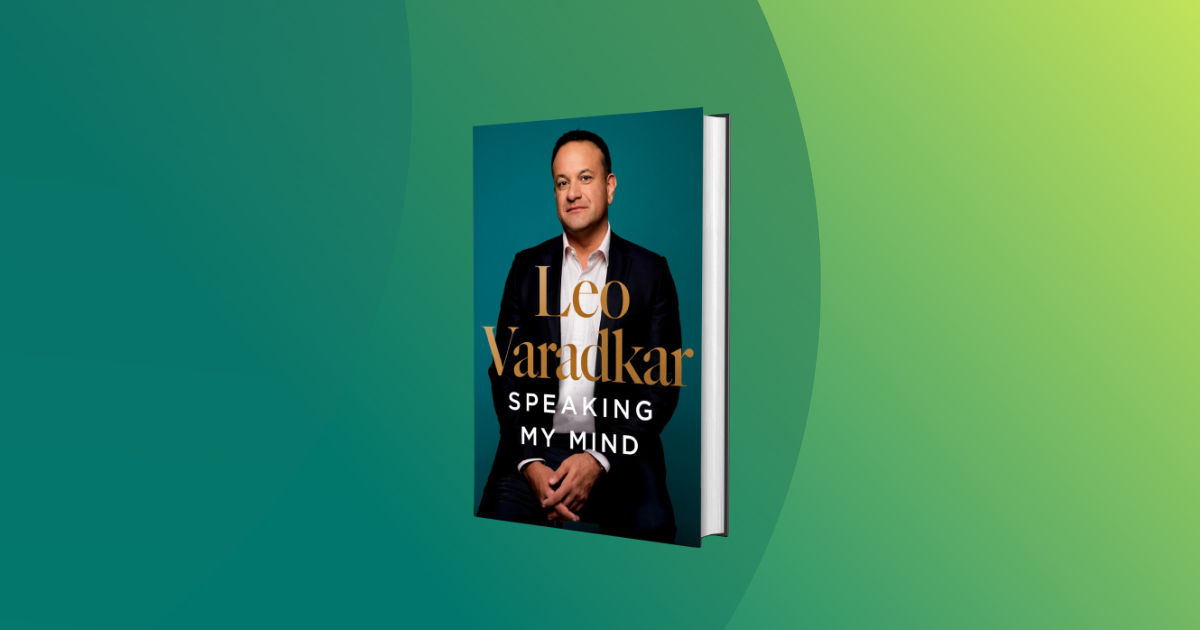
Leo Varadkar
Speaking My Mind
Dublin: Sandycove (an imprint of Penguin Books Ltd.
432 pages
2025.
ISBN 978-1-84488-693-7
After first meeting Donald Trump, Leo Varadkar concluded the president was “intelligent and cunning, someone who knew how to ensnare people, what buttons to press and how to get attention.” The comment reveals a lot about both men. Leo’s first impression of the one-of-a-kind president was based on what he saw before his own eyes and seemed free of the preconceptions an Irish politician would be expected to bring, based on the incessant denigrating commentary that was, and is, the staple of Irish media outlets. Having read the 405-page memoir, one might conclude that Varadkar shared the same qualities, though with some striking differences. The conspicuous lack of “knowledge” that Varadkar observed in Trump, which made an odd combination with his equally noticeable intelligence, was not something that Varadkar shared. The temperaments of the men are different. Varadkar, guarded and methodical, and Trump, brash and impulsive. They share the same steely ambition and an ability to play others to their own tune in their very different styles. The other rather interesting difference is that while Trump loves both power and its trappings, Varadkar is way more interested in the trappings. Even the perk of having a Garda driver to bring him home “after a late night out” is something he thinks worth mentioning.
This memoir charts the measured ascent to power of a man from a comfortable middle-class family who was always obsessed with politics and public affairs. A career in medicine as a general practitioner, like his father, was his family’s plan for him, and he went along, somewhat lukewarmly, with their wishes, but not without realising quite early on that being a doctor was a decided help in launching a political career. From his university days, he was active in party politics and rapidly rose from county councillor to TD, abandoning his medical career before it was ever really established. This account of his very eventful life follows a chronological path, making chapter titles no more than markers of a significant point on the journey that move rapidly on to other things after a page or two. His path to the top was carefully planned through the inevitable “events” that bedevil political ambition and required several course corrections.
For Varadkar, every political brief was a step to realising his ambition to be Taoiseach. He certainly brought to each task dedicated attention and considerable ability, but he is quite frank in admitting his aim was to impress, to make a mark as an effective politician, capable of going all the way to the top. His diligence paid off, and he found himself, as he boasts, “the youngest Taoiseach ever to be elected.” He was, he tells us more than once, “the right person, in the right job at the right time.” His role in the Brexit process meant more than contemporaneous fame; it meant he would “be written into the history books.”
Varadkar’s parliamentary career is now behind him at the mere age of forty-six, not so much because he “fell out of love with politics” but with the idea that politics was everything. Surprisingly, he allows himself to come across as narcissistic and venal, but it seems part of the surprising artlessness with which the book is written. He even owns up to buying a disco-ball lamp online from a supplier in Hong Kong, which led to a security alert in his office when he was far away in the US. He is open to listening and learning from others, he claims, even from those who hold very different political opinions, such as President Higgins and Clare Daly. However, an alert reader might wonder why he only ever talks across the ideological aisle to those who, though they may differ with him on economic policy, nevertheless share his social progressivism. On the contrary, he appears to conflate social conservatism with “far-right populism.” To be fair, his position can be more nuanced than many of his liberal colleagues’, as when he acknowledges that the mistreatment of unmarried mothers and their infants was largely because of rejection by their own families.
What drew me to this book was curiosity to see if it would reveal what makes Leo Varadkar tick. If we know that, then there is a good chance we also know what makes the political culture of our time tick, and maybe even better understand what makes Varadkar’s generation tick—the people now raising the adults of the future. And yes, the book does offer some answers to those questions. Varadkar inhabits a world where certain obvious avenues of discussion and reflection are completely and bizarrely off limits. If we accept, as common knowledge, that the only questions we fear to ask are those we don’t want to hear because we know them already and don’t want to deal with their implications, we can start to “get” Varadkar and those of like mind.
The repeal of the Eighth Amendment in 2018 offers a good example of this cultivated myopia. Varadkar disingenuously sticks with the slogans and pitches of the campaign that secured the “Yes” side such a decisive victory, as if the last seven years offered nothing at all to challenge them. With an extraordinary level of denial, he repeats the “safe, legal, and rare” argument, as if his intentions back then matter more than his failure to realise them. He cites the hard scenarios of the X, Y, and P cases with complete disregard for the far more frequently occurring hard cases arising from the provisions of the Abortion Act itself. As a medically qualified Taoiseach, he would have been aware from the beginning of what we all know now—the shocking cases of little aborted human lives surviving the procedure for long enough to be handled by the professionals who performed it. Neither has he anything to say about the ever-rising abortion numbers or the horrific risks of relying on foetal screening to determine if a baby has “a fatal foetal abnormality.” Any one of those uncomfortable realities would certainly, at minimum, stymie current discussion towards making abortion even more readily accessible than it already is. That, in turn, of course, would open up even more unsettling questions with implications that politicians like Varadkar could find very challenging indeed.
In similar vein, despite the foreseen and unforeseen consequences, confusion, and ongoing controversy around transgenderism internationally, Varadkar says he still “stands by” the science-blind, radical Gender Recognition Act, which swiftly followed the repeal of the Eighth Amendment and as a result slipped into law before the opposition could be scrambled. The same blinkered mindset is evident in his dismissal of the threat from radicalised immigrants to the safety of Irish citizens. In fact, it shows an even more astonishing level of disconnect and denial. On hearing of the shocking knife attack on little children outside a crèche in Dublin’s Parnell Square, his first concerns are that “the far right” would provoke civil unrest or even violence. His reaction reveals that he himself suspects the perpetrator is of non-Irish origin, which indeed proved to be the case. Yet he categorically and disingenuously denies there is any correlation between this kind of crime and newly imported cultures. He doesn’t have to point out that there is far more knife crime among the native population. People largely know and accept that. But they also recognise that new patterns of violence, which include opportunistic random attacks against the most vulnerable and undefended, have a different kind of motivation—one we have seen already many times in other countries with higher levels of unscreened immigrants. That is the inconvenient reality that is undermining the liberal project to diversify our population and marginalise those who threaten the dominance of liberal ideology.
We see the same disjointed thinking again and again. Despite his recognition of the failures of families to support their daughters during the era of Mother and Baby Homes, he does not see the escalating crisis of “gender-based violence” in the home as indicative of the failures of the families of our own time. Neither did he or the Minister for Justice, Helen McEntee, for whom the issue was a pressing priority, ask themselves how abolishing constitutional recognition of the family founded on marriage and the work of the mother in the home could improve the situation. Even though the failures of State and Church in the past were downstream of the failures of families, the only solutions to domestic and other forms of violence against women either of them considered were at the level of State intervention. Promotion of the nuclear family as a healthy social milieu and the optimal environment for providing children with security and safety could not be admitted by those bent on promoting diversity of relationships.
This brings us to the heart of the cognitive dissonance displayed by the socially progressives like Varadkar. It can be summed up in the feminist slogan, “The personal is political.” Varadkar acknowledges that his own journey from early social conservatism to social progressiveness paralleled his journey into adopting an openly gay lifestyle. Varadkar gives a very candid account of how gay relationships are different. Gay meeting places are “edgier,” but they also offer “safe places” for young men, not already fully “out,” to “experiment.” Curiously, they are also places for partnered men like himself to experiment as well. Such relationships bear no resemblance to any understanding of marriage as an exclusive partnership and go some way to explaining why many leading campaigners for same-sex marriage in 2015 were the same people who campaigned for the removal of the constitutional recognition of marriage nine years later. For them, it appears what they called “marriage equality” was more about equality than marriage. Logically then, their success in that campaign was merely a step on the way to giving others, for whom marriage wasn’t a natural fit, parity of esteem within a much broader, more inclusive definition of “family.”
Openly departing from norms in one’s own life doesn’t give one authority to impose them on others. Abandoning even one moral directive which set boundaries in the past is really ultimately an abandonment of all other norms too. As someone observed, you have only to ask one question about a person’s position on a given moral issue, and you know their position on a dozen others. Leo Varadkar was a child of secular parents, even though he and his siblings received Holy Communion and Confirmation because “fitting in was important.” For Varadkar, most of his generation, and Irish politics today, “fitting in” is coming, and has already come in many respects, to mean something very different. Only the imperative to conform remains the same. Varadkar is speaking his mind, yes, but the voice of the culture that shaped him is also coming through loud and clear.