
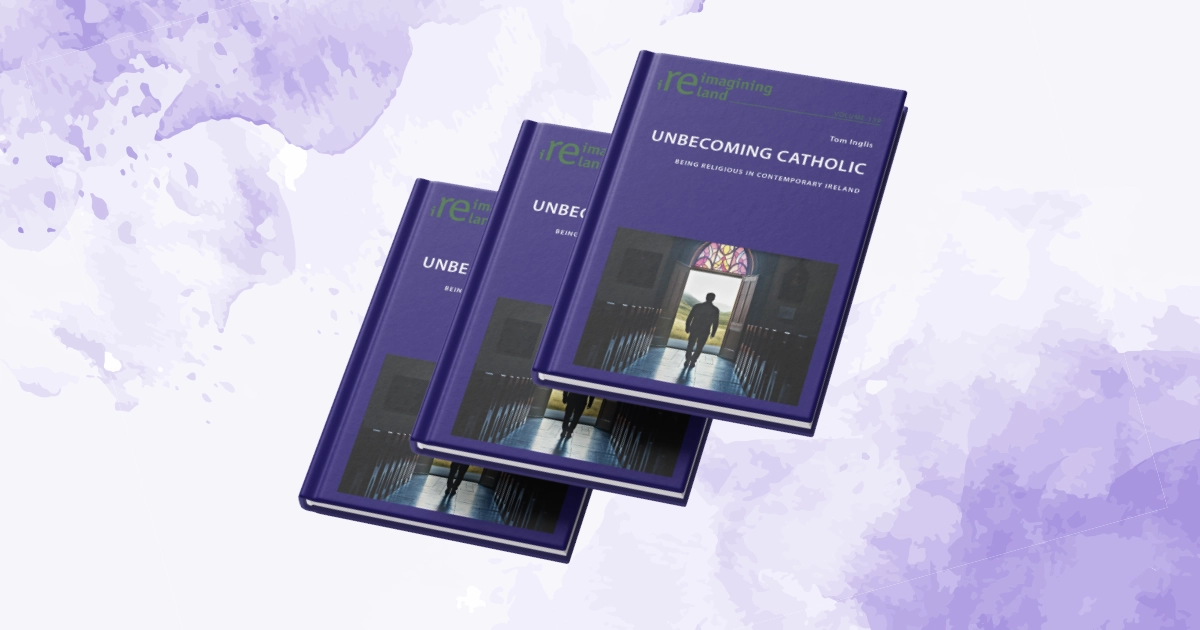
Tom Inglis
Unbecoming Catholic: Being Religious in Contemporary Ireland
Dublin: University College Dublin Press
April 2025
200 pp.
ISBN 978-1-80374-817-7
Moral Monopoly: The Rise and Fall of the Catholic Church in Modern Ireland appeared in 1987, and the astute observations of UCD sociologist Tom Inglis have stood the test of time. His book about the Church’s influence in Irish society remains influential, which is why the relative lack of attention shown to his new work is surprising. Unbecoming Catholic: Being Religious in Contemporary Ireland is also insightful, and it says a great deal about how Irish society has changed in the lifetime of its author.
Inglis begins his personal account with a description of a yoga tree pose that he does daily. By his own admission, he is not sure why he engages in this balancing and breathing act—whether it is about soul searching, spirituality, or simply the maintenance of good health. Having decided to stop describing himself as Catholic, Inglis is in the process of asking questions. His answers are somewhat vague, but the overall examination is telling.
The decision Inglis made when completing his census form in 2022 was part of a societal shift. In all, more than 736,000 people ticked the box stating “No religion,” up from 451,000 in 2016 and 256,000 in 2011, and the pace of de-Catholicisation is accelerating. Between 2011 and 2016, the figures suggest there was an annual decline in the Catholic population of 1.18 per cent. The drop in the Catholic percentage between 2016 and 2022 suggests an annual decrease of 1.55 per cent. Just over two in three people say they are Catholic now, and if this rate of decline continues, only a minority of people in the Republic will identify as Catholic in 2035.
Inglis does not necessarily welcome this, and is not an instinctive anticlericalist. In fact, he appears to embody many of the contradictions within the overall population. He likes churches and still gets “a tingling sensation” when visiting one. Though he believes that the Church has too much of a role in the education and healthcare sectors, he values his own Catholic schooling (despite the brutality of some of the De La Salle brothers), and he was happy to send his daughter to a school run by the Dominican sisters. When his wife died, he knew that despite her irreligiosity, there was only one appropriate venue for the funeral—which was not only “beautiful and enchanting, but big enough for all those who would want to attend”—the nearby Church. With the assistance of a priest friend, the funeral Mass took place there and balanced what he calls “the doctrinal demands” with the family’s wishes. “I bitch and scream about the Church but, when in need, reach out to it for help,” he admits.
Many of the lapsed Catholics in Ireland have the same attitude, but are not honest enough to admit it. Inglis is rightly concerned that the majority of former Catholics show little appetite for exploring religion more deeply, but his interest in various New Age practices appears misplaced, as does his belief that the increased interest in nature and environmentalism will fill some part of the spiritual void.
After describing his own teenage struggles with a Catholic religion that to him seemed fixated on sexual sin, Inglis describes his own environmental failings in near-identical terms. “I sin against nature,” he writes. “I drive my car, travel in planes, eat meat and chicken, wear cheap clothes made in Asia. I imagine that every time I do so, I am driving another nail into the womb of nature. They may be venial sins, but they mount up. There is no sense of shame…I imagine going regularly to confession to a personal admonitor or counsellor who would help me to live better.”
The modern environmental movement frequently wraps itself in religious garb, with its high priests preaching about the coming climate Apocalypse and with Greta Thunberg rallying members of a purposeless generation for a “Children’s Crusade.” But what today’s environmentalism lacks is not a greater awareness of sin or impending doom, or a system for resolving guilt in a carbon-neutral confessional box. The movement’s most glaring inadequacy is its inhumanity. Many green activists openly see mankind as a parasite sucking the life from the natural world, rather than seeing that world as a gift which humans have an obligation to protect.
A logical consequence is the dogmatic support for abortion, euthanasia, and population control. The guilt-based environmentalism Inglis craves is not going to substitute for the deterioration of the spiritual realm. Instead, the failure of the world’s people to accomplish the impossible will sow disillusionment in many and foster extremism in some.
One of the most striking aspects of Inglis’s search for meaning is not the diversity of his winding journey around the world and its traditions, but the individualistic nature of the quest. “It has taken me a lifetime to try to transcend the Roman Catholic way of being into which I was socialised. It has taken the last twenty years for me to realise that I am as religious as any priest, nun or bishop. It is just that I am religious in my own way. I believe that if there is a God, he, she or it, can only be known through nature. I don’t believe in heaven or hell. I have my own rituals. I don’t go to Mass. Most days I walk a county lane near where I live. I feel immersed in nature and maybe God. I say my own prayers. I sing my own hymns,” he writes.
He was indeed socialised in the Church as a child, for Catholicism is a social religion. Many of the political battles Catholics have fought in recent decades have focused on a defence of social bonds against liberal individualism: upholding the indissolubility of marriage, the sanctity of unborn life, and so on. Through the national journey of Unbecoming Catholic, Ireland has consciously chosen the individual over the social, and choice over tradition. Unsurprisingly, the process has coincided with a dramatic social transformation in which Ireland has become the loneliest nation in Europe, according to research by the European Commission.
Inglis acknowledges the growing evidence of societal atomisation in the United States and elsewhere, but suggests that loneliness is a consequence of urbanisation, as if nature, trees, and tree poses will save us. He rightly points out that religion in the West has “become more private and personal…a matter of individual choice,” but fails to appreciate the societal damage which has been wrought.
Given that Inglis is a sociologist, one of the most curious elements of this book is his acknowledgment of the positive role the Church has played in Ireland: an acknowledgment that is not followed by any real reflection as to its implications. “Two hundred years ago, the laity needed the Church to become self-disciplined, modern and civilised,” he writes. The two-hundred-year cut-off is irksome—Irish Catholicism does not start with Emancipation, the Famine, or the Synod of Thurles—but the point is still significant. In Moral Monopoly, Inglis went further, writing that the “Catholic Church played a major role in popularising and disseminating civilised behaviour throughout Europe and the rest of the world.”
This contribution usually goes unacknowledged by secular commentators in Ireland or elsewhere, with good reason. What happens when the religious roots of a society are hacked away? Do they continue their ascent in culture and education, or do they regress? The value of Catholicism, Desmond Fennell once wrote, “becomes palpably evident as its influence on lives diminishes and nothing emerges to fill the vacuum.” This is more true now than ever. Inglis appears wildly optimistic when he writes that the Irish people have retained their “culture of self-denial and humility.” A glance at the national newspapers or the capital’s streets should have disabused the author of such notions.
Self-denial is not something that post-Catholic Ireland specialises in. The country’s first ever experience of material prosperity was accompanied by gratuitous overspending and ended in disaster; a similar process could unfold soon, and for the same reason—an inability of the Irish people to exercise self-restraint. A level of violence and coarseness in Irish life is now taken for granted, and crimes that shocked 1980s Ireland are now quickly forgotten.
Inglis writes here about how his own search for transcendence has in the past involved much cannabis use and occasional experimentation with acid. Here, as elsewhere, he speaks for many pleasure seekers in a country that is the fourth-highest consumer of cocaine globally. Family life is drastically poorer than it was a generation ago. Around 10,000 abortions take place annually, and the topic is now considered suitable comedy material for breakfast television.
Unbecoming Catholic is as good a title for a documentary film on modern Ireland as it is for this book. All that is left after reading it is the image of a distinguished and half-naked UCD sociologist, standing on one leg and doing a yoga pose, for reasons as unclear to the reader as they are to him.