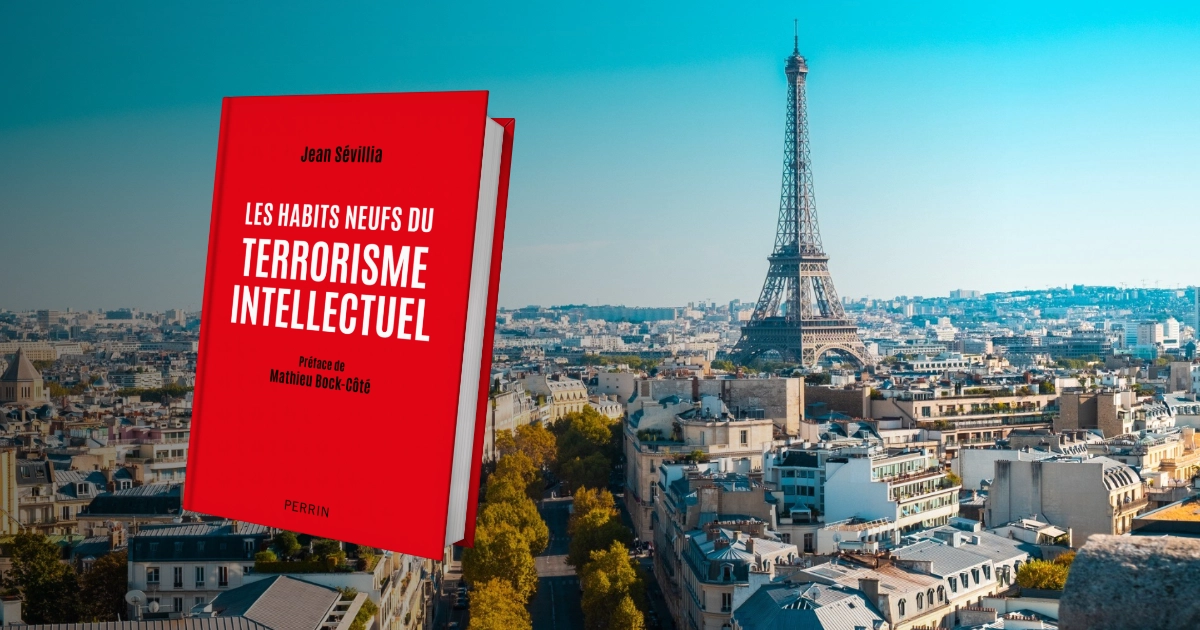
Jean Sévillia
Les Habits Neufs du Terrorisme Intellectuel (The New Clothes of Intellectual Terrorism)
Paris: Perrin, 2025
ISBN 978-2-262-09935-0
Those who worry about a lack of fairness and ‘groupthink’ in public debate in Ireland may have lessons to learn from similar experiences in other countries.
Earlier this year, the French historian and journalist Jean Sévillia published an extensively researched account of what he calls ‘intellectual terrorism’ in France. This is certainly a forceful expression, which the author applies to the control of public discussion by ‘political correctness’ and the enforcement of a progressive consensus by the denial of any legitimacy to alternative views or to those who hold such views.
As his book suggests, that progressive consensus has changed over time in France: just after the war, and under the influence of the French Communist Party, it was Stalinist; it later became Maoist, Third-Worldist, May-’68ist, deconstructivist, globalist, multiculturalist, and wokist. (May 1968 was when a major student revolt took place in Paris.)
Sévillia has previously published a remarkable analysis of anti-clerical French legislation in the early twentieth century, When Catholics Were Outlaws, and has written on many other topics—for example, political correctness in history, Austrian opposition to Hitler, and the Algerian War.
This book was written before the vote in favour of ‘assisted dying’ in the French Parliament in May, but it covers the decision of the Parliament in 2024 to enshrine the right to abortion in the Constitution—and thus to attempt to rule out any future discussion in France on the rights of the unborn.
Some similarities may be noted between the French experience and our own restricted debate in Ireland on issues such as the right to life, appropriate immigration policy, or the federalist direction of the European Union. In both countries, dissenting arguments are often classified as ‘far-right’ and thus disqualified from consideration, while there is no equivalent analysis or even identification of ‘far-left’ positions.
Progressive groupthink is possibly even more entrenched in France than in Ireland—or, at least, goes back further in time. Sévillia sets out how the teaching of the history of the French Revolution was heavily influenced for decades by Marxist professors, many of whom were brilliant scholars, until, from the 1960s on, pioneering academics like François Furet began to question established dogmas about the Revolution and identified its totalitarian aspects, including, in the research of Reynald Secher, its brutal treatment of a Catholic uprising in the Vendée region.
Moving to more recent times, Sévillia documents the moral blindness in the 1950s of a left-wing French intellectual class, led by the philosopher Jean-Paul Sartre, towards the reality of the Soviet Union, its Gulag labour camps, and its lack of fundamental freedoms. It was only after the Soviet interventions in Budapest in 1956 and Prague in 1968, and the revelations of Gulag survivor Aleksandr Solzhenitsyn, that a change of heart among these Communist ‘fellow travellers’ began—very slowly—to take place.
On immigration policy, Sévillia adopts a low-key and facts-based approach and assembles a range of statistics. For example, the number of new, legal immigrants in France in 2022 was almost 500,000 people—about five times the annual figure in the 1980s. This figure does not include illegal immigrants, and the book reports that around 20 percent of expulsion orders for such immigrants are implemented. He contends that it is a ‘taboo’ subject whether large-scale non-European immigration risks damaging the cohesion of French society and argues that France has been changing into a multi-ethnic and multicultural country without any significant consultation of its previous population.
Taking issue with criticisms of French ‘racism’, Sévillia argues that France is not a race but a nation, or a ‘community of destiny forged by history’. French people, he contends, do not, in general, reject foreigners but rather oppose the ‘multiculturalist’ approach. Large-scale immigration, he argues, does not cause an ethnic or racial problem but a cultural, political, and national problem.
The author’s focus in this book is on left-wing ideology. In the interest of balance, one might refer to scandals associated with conservative ideology—for example, the anti-Semitism on display during the controversy about a Jewish army officer, Alfred Dreyfus, in the 1890s, or the collaboration between the Vichy regime and the Nazi occupation in the 1940s. It was also under a centre-right government, though with Socialist Party help, that abortion was legalised in the 1970s. The author’s point is that left-wing ideology has been dominant since the 1940s and that the centre-right has focused on economic issues but has neglected cultural or ‘social’ issues.
Sévillia’s critique of a ‘progressivist’ dominance in French debate is informative, courageous, and meticulous in its research. One conclusion to be drawn is that progressive groupthink impedes proper argument and discussion and that there is a need, in our democracies, for wide-ranging and fair, facts-based debate.
The key principles of Catholic social teaching—that is, the dignity of the person, subsidiarity, solidarity, and the common good—go beyond ‘progressive’ or ‘conservative’ categories and offer valuable criteria on which policy choices may be judged. The principle of subsidiarity, for example, suggests that the nation-state does have the right to control its borders, while the principle of solidarity points to the need for compassion and respect for all those whom one meets, whatever their cultural background. There is a need for greater discussion in many countries on how compassionate and respectful outreach to the stranger in need may be combined with a realistic immigration policy that protects the legitimate interests of the receiving nation-state. This publication suggests, however, that a policy of brushing aside immigration concerns on ideological grounds has worked no better in France than in Ireland.
Sévillia’s book is a revised and wide-ranging version of a best-seller first published in 2000 and would merit an English translation in the future. It covers, among other topics, the ‘woke’ agenda, the colonial experience, attitudes towards the EU, Islamism, Solzhenitsyn, the race issue, politics and the National Rally party, and the impact of television on French society.
The book concludes with some words of hope about the future of public debate in France. New technology, the author argues, has somewhat lessened the hegemony of political correctness in traditional media, and alternative voices are getting more airtime than a generation ago. Sévillia was himself interviewed about this book in the popular magazine Paris Match—an interview that might not have happened a decade or two ago.
At a deeper level, while France is experiencing a time of great uncertainty, Sévillia reminds readers that the country has recovered from major previous traumas, such as the Hundred Years’ War, the Terror under the Revolution, or the German occupation during the Second World War. He suggests that the dramatic rebirth of Notre-Dame Cathedral from its near-death experience in 2019 can nourish hope of rebirth for the nation as a whole.