
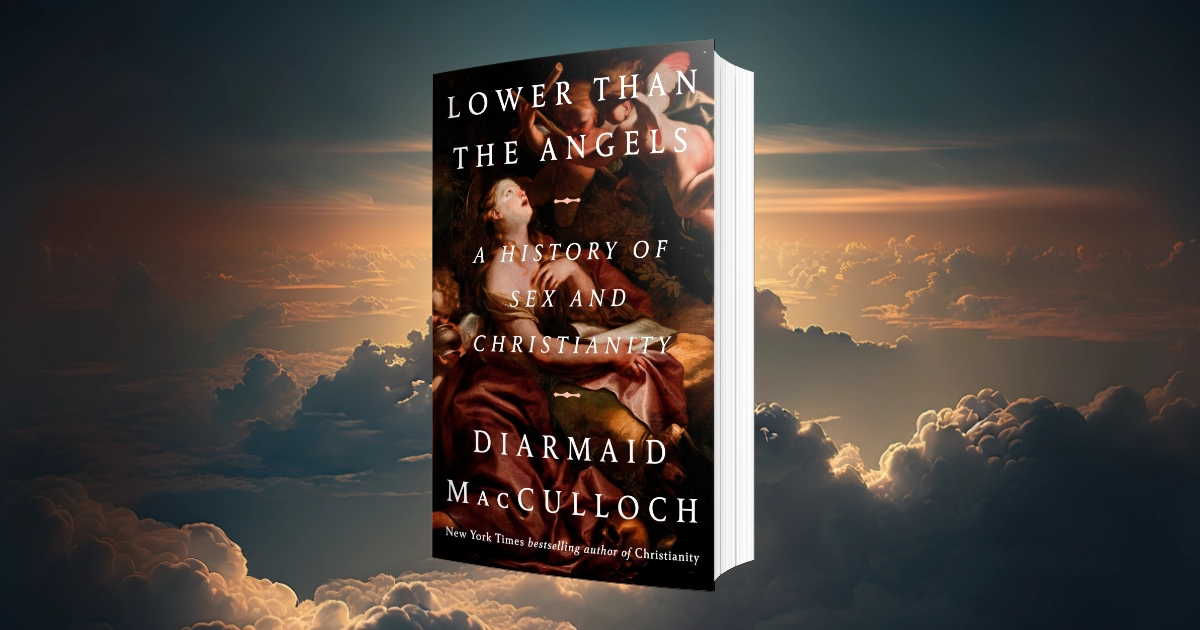
This book is quite a tome from Diarmaid McCulloch, Emeritus Professor of the History of the Church at Oxford University and author of acclaimed works on Church history. The book’s brief is to prove that, over 4,000 years of faith history, there was no one settled theology of sex but many contending theologies—and that we continue to explore new ways of understanding our sexual nature and the ways in which it can be legitimately expressed. Such a wide sweep across time and Western civilisation goes some way to explaining why it took the author almost 500 pages to develop and prove—as he believes he unequivocally did—his case.
Such a very broad field of research, in terms of both history and geography, offers opportunities for cherry-picking and confirmation bias, so it is important to say a little about the personal background of the author. He is openly homosexual, an ordained deacon of the Anglican Church for whom priestly ordination was not permitted because of his stand against what was then the prevailing Anglican orthodoxy. Of course, having a vested interest in a subject does not preclude a scholar with access to vast reserves of historical data from arriving at just and honest conclusions. While a lot of this book’s historical narration is true to fact, there is a tendency, noticeable from the start, to join dots—to posit connections, in other words—that support his central thesis: that Christianity has no fixed and cohesive theology of sex and marriage; that Scripture does not support such a theology; and that it was a small number of male and often celibate churchmen who “created broad currents and shapes with Christian doctrine.” The course was set early on by seminal Judaic and Christian thinkers such as Philo, Justin Martyr, Origen, Tertullian, and Jerome—the last-named carrying most of the blame for what McCulloch sees as the deep misogyny that remains an intrinsic element in Christian theology of marriage and sex.
There are more speculative, and frankly subjective, takes in this book than one might expect from a distinguished academic in the field of ecclesiastical history. Maybe, might have, and likely are not terms he shies away from. He even cites a source—Epiphanos, a fourth-century bishop in Cyprus, whom he acknowledges as “occasionally reliable”—to posit the theory that Jesus was the son of a Roman soldier and Mary a victim of rape. To draw out what he claims is the unsettled, shifting nature of the Church’s theology of sex, he not only casts a very wide net but draws out, in no particular order, whatever serves the argument of the moment.
To undermine the traditional understanding of the Holy Family, he cites the conclusions of some modern scholars that the birthplace of Jesus was unlikely to be in Bethlehem because the time didn’t coincide with the census of Caesar Augustus, which has been recorded as taking place in 4 AD—which McCulloch always refers to as CE. It is interesting he gives the year as 4 AD, because Christopher Hitchens in his book God Is Not Great places the census in the year 6 AD. For McCulloch, the infancy narratives in the Gospels rest entirely on “literary devices”—a retrofitting of Old Testament prophecies into the life of Jesus.
There is nothing novel in pointing out that literary device is used in the infancy narratives of both Matthew and Luke. However, the narratives are indeed framed in a precise historic period and use names of actual people and places—Bethlehem, Augustus, and Quirinius. This historical triangulation has been accepted by both tradition and scholarship up to recent times. Newer evaluations remain contested and should certainly not be presented as disinterested scholarship when they are clearly used as convenient grounding for the author’s theories. For McCulloch, Scripture is the work of human minds, reflecting the limitations of human knowledge, the prejudices of the times, and the agenda of its authors.
He cites others who, like him, see the Gospel as a densely layered narrative to be read, understood, and relativised within the frame of lived experience rather than as a depository of unchanging truth that, supported by the Church’s interpretation, interrogates lived experience. With this mindset, he dismisses the male–female family paradigm in the Book of Genesis as something of inconclusive significance, since it is presented in two very different versions. While he does not dismiss the Gospels in the same way—despite the fact that they too are narrated in various versions—he certainly feels they allow him to engage with them in a way that answers to his “lived experience.”
Referring to the fact that God did not reprove Abraham for his polygamy, or that nothing negative was said in relation to the intense emotional bond between Jonathan and David, he infers that polygamy had legitimacy in the eyes of God and, in a two-step inference, that David’s relationship with Jonathan was likely to be carnal—and that God didn’t count that as an impediment to choosing David as leader of his people. Arguments from silence are speculative. Quite ingeniously, if not disingenuously, he uses the common trope among Christian LGBT+ activists that the people of Sodom and Gomorrah were destroyed because of their lack of welcome for the prophets rather than any sins they may have been guilty of. He cites Jesus’ reference to the destruction of those cities in Matthew 10, when he compares their fate to the fate of the towns that would reject the teaching of his apostles. Accordingly, for him, the sin that merits punishment is the sin of “inhospitality,” not promiscuity or any other sin. This kind of perverse argumentation is typical of McCulloch. His position here is like insisting that a person who objects to a burglar in their house is objecting to the intruder’s lack of good manners.
He offers a new take on the marriage at Cana by pointing out it was a secular celebration of a legal contract. He doesn’t mention the fact that it was within the Jewish understanding of marriage at the time, which had moved on from the polygamy of the patriarchal age—something McCulloch credits to the influence of the more monogamous Greek and Roman cultures. He observes that it was not until the fourth century that the Church began to celebrate marriages in a religious ceremony. However, McCulloch does not miss the point that marriage, in both the Old and New Testaments, is a metaphor for God’s relationship with his people and Christ’s with his Church. He appears to accept the view that if Jesus’ great act of covenantal love is a once-and-for-all-time action, then marriage is also to be understood in the same way—a tacit rejection of divorce. McCulloch bypasses what Cana signifies about Mary’s maternal influence and her intercessory power, as well as familial and marital obligation. He goes on to argue that Jesus sets little store by family ties, citing what he characterises as his dismissal of Mary in Matthew 12, when he says that those who do the will of the Father are his “brother and sister and mother.” Our obligations to God, of course, have primacy, but they include adherence to his commandments, which are very specific on familial and spousal obligations.
McCulloch acknowledges St. Paul’s affirmation of mutual spousal love and the reciprocity of obligations within marriage, but argues that, over the following centuries, the Church accepted the cultural understanding of marriage as largely about securing property and succession in a contract brokered between the fathers of a couple—something that didn’t necessarily involve love at all. The Church’s acquiescence, uneasy or not, with all kinds of worldly ways of organising society was, and remains, distinct from actively realigning its teaching with secular norms and ideologies. The latter enterprise seems unique to our own time, where mere acquiescence with the ways of the world is not enough; explicit doctrinal conformity with the zeitgeist is also demanded. McCulloch name-checks some of his fellow radically reforming churchmen in the area of sex and marriage, such as Archbishop Tutu and former Archbishop of Canterbury Dr. Rowan Williams.
While it may strike the reader that Catholicism has kept more aloof from the dismantling of traditional mores in this area, it must be pointed out that the span of this book is from antiquity to the present time, so much of the historical context is shared by all Christians. It is also true that a similar deconstruction is all too evident within the fold of Catholicism, and McCulloch points out that, for most self-identifying Catholics, the Church’s teaching in Humanae Vitae is a dead letter.
Not only does the book span some four thousand years of Judaic-Christian history, it also arguably digresses into tangential areas to allow McCulloch to demonstrate that the development of Christian teaching was haphazard, under the sway of whatever outside cultural influences most impinged on it, as well as the patriarchal sexism that asserted itself in its early defining years. He writes that the monastic, celibate tradition came to Christianity from Indian Buddhism. One can equally hold that the forty days of Jesus in the desert and the Essene Judaic tradition were the more significant formative influences. He also states that the attraction of monastic life for women was that it offered an escape from “enforced marriage.” Yet the foundresses of the many women’s religious orders were women in command of their own wealth. His cherry-picking crosses and recrosses centuries. The Emperor Constantine, he tells us, was a cruel man at the head of a cruel regime who continued his empire’s cruelties after his conversion.
It must strike any thoughtful reader that the full implications of giving ourselves to Christ unfold over our entire lives—and what’s true for individuals is even truer for whole societies and systems. He points out that the doctrine of the Immaculate Conception was not formulated before protracted and contentious debate, with different religious orders on different sides, in order to show that the Church is not only a family of identities but of opposing identities, and that truth comes down to the opinion that prevails among the most influential. One can counter that careful deliberation before a definitive resolution should reassure rather than unsettle, especially in the light of Christ’s pledge to be with his Church through the ages.
McCulloch casts far and wide to sow skepticism. Noting that St. Paul appoints a diakonos called Phoebe, he suggests that the early Church was tending in a more gender-inclusive way before the Fathers took control. Again, there is much in the writings attributed to St. Paul that conveys a clear sense that our differences are significant and that each person’s individual qualities and gifts—and that includes gender—contribute in a unique way to the building up of the body of Christ. The Fathers wouldn’t be so influential if they were not thinking with the Church. Perhaps one can say, in the words of Gamaliel, that if Scripture’s understanding of the significance of our binary, gendered humanity were of little or no account, it would not have so embedded itself in the Church’s enduring traditions, even in the face of immense pressure from secular cultural reformers in our period of history.
McCulloch concludes his case by claiming to have established that Christianity is “a family of identities,” and that this is reflected in a diversity of doctrine and practice—even if that diversity has been masked by the emergence of a dominant line of dogmatic teaching. Perhaps what he is describing is something we already understand as a multiplicity of heretical strands that the Church has had to resist and defeat in every age of its existence. Since the sixteenth-century rupture of the Reformation, that task has become the enterprise of the Catholic Church, while “the family of identities” has continued to further proliferate and merge with secular ideologies that are muddying its core identity to the point of obliteration.
The significance of this book is that it typifies what I will call the modern dialectic of “gaslighting,” which is more and more a threat to truth-telling. Gaslighting is about casting light in a way that manipulates reality—highlighting some things, distorting others, and intentionally allowing certain things to be lost in darkness and shadow. You can’t really challenge this “reality” without appearing to deny what’s in front of your eyes—what’s repeated over and over by “reliable” sources. Like the character in the 1938 play Gas Light, from which the term derives, you may not be convinced you are mad, but you may lose confidence on perceiving that others think you are.
This explains why resisting the bizarre dogmas of our time depends so much on thick-necked mavericks, who may bring their own kind of conspiracy-laden gaslighting to the task of resisting manifest falsehood and outright nonsense. They are like the artless child in the fable of The Emperor’s New Clothes—except that, in our time, very few are prepared to say they agree out loud.